
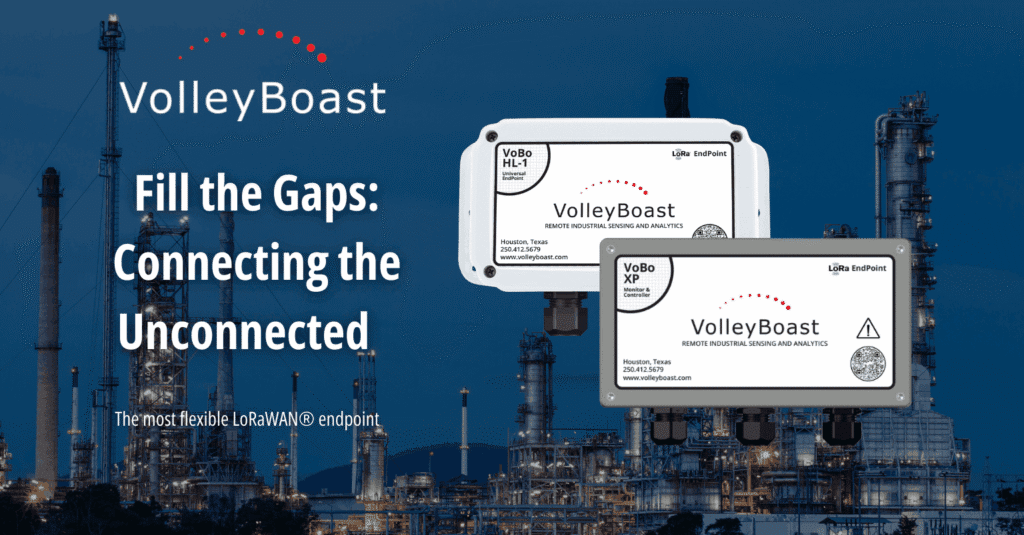
The core mission of the Internet of Things is to connect the unconnected. Yet across industrial, municipal, and infrastructure environments, a large percentage of critical operational data remains trapped by devices that were never designed to communicate with a network. These gaps limit device visibility, slow response times, and weaken a company’s digital transformation initiatives. VoBo is the solution for connecting the unconnected because it directly addresses and solves the real-world challenges that prevent legacy and remote assets from becoming part of modern data systems.
What Does “Unconnected” Mean?
Unconnected assets are instruments and systems that generate valuable information but are not connected to a network. These assets often include mechanical gauges, legacy pressure and flow instruments, discrete sensors, and monitoring points that must be read manually. Data from these assets is only available after a technician visits the site, records the values, and returns the data to the office for processing. Gathering the data can be time-consuming, and by the time the data is captured in a system, it is often already outdated.
Unconnected can also apply to new monitoring needs. Organizations sometimes determine additional parameters they want to measure, but the lack of power, communications infrastructure, or budget prevents these measurements from being taken. As a result, critical data never enters the system.
The Core Challenges of Connecting the Unconnected
Connecting the unconnected involves many challenges, including overcoming practical, financial, and operational constraints that are common in many industrial environments.
One major challenge is infrastructure. Many unconnected devices are in remote or widely distributed areas where running power and communication lines are cost-prohibitive or physically impractical. Trenching, conduit, and network extensions often cost more than the instrumentation itself.
Another challenge is legacy compatibility. Existing instruments were designed to be read locally rather than integrated into modern networks. Replacing them with smart devices requires capital investment, downtime, and retraining. All of this creates resistance to change and is costly.
Power availability is also a limiting factor. Many locations do not have a reliable power source, so traditional wired or high-power wireless solutions are not usable.
Operational disruption is another challenge. Any solution that requires taking assets offline, redesigning control systems, or modifying proven workflows introduces risk. Organizations are understandably cautious about changes that could negatively impact safety or uptime.
Scalability is always an issue. Even with a successfully launched project, solutions that rely on centralized gateways, custom engineering, or complex configurations often become difficult to scale across hundreds or thousands of devices. Scaling becomes costly and time-consuming.
Why Traditional Approaches Fall Short
Conventional approaches to connecting those unconnected assets typically involve replacing instruments, extending wired networks, or deploying high-power communication systems. These methods can work in limited cases, but they don’t scale efficiently. Costs rise quickly, deployment timelines stretch out, and the return on investment becomes difficult to justify.
As a result, many organizations postpone their connectivity initiatives, leaving critical data locked away and unusable. Their digital transformation efforts stall and are eventually forgotten.
Companies need a real solution to this problem that is both cost-effective and scalable.
How VoBo Solves the Challenges
VoBo is the solution for connecting the unconnected. It is designed specifically to overcome all of these obstacles.
VoBo eliminates the need for new infrastructure by leveraging long-range, low-power wireless LoRaWAN communication. This allows devices in remote or difficult-to-reach locations to be connected without trenching, cabling, power, or network expansion.
VoBo solves the legacy compatibility problem by collecting data from existing instruments rather than replacing them. Devices that have been proven in the field can remain in service while VoBo provides the digital bridge that brings their data into modern systems. This approach protects previous investments and avoids unnecessary downtime and re-training.
Power constraints are addressed through VoBo’s low-power design and battery operation, allowing for long-term installation in locations where power is unavailable or unreliable. This makes the VoBo practical to connect devices to the network that were previously considered unreachable.
Operational risk is minimized because VoBo deployments are non-intrusive. Installation does not require taking assets offline or modifying core control systems. Data collection can begin immediately without disrupting existing workflows.
Scalability is built into the architecture. Each VoBo operates independently, and most models can connect to multiple sensors, so adding new monitoring points does not increase system complexity. Connectivity and data capacity scale naturally across the network as more VoBos are added.
Turning Gaps into Continuous Visibility
By solving these challenges, VoBo transforms isolated instruments into connected assets that deliver reliable data. Manual readings become automated data streams. Delayed information becomes timely insight. What was once a fragmented view of operations becomes a cohesive, data-driven picture. With the optional VoBoSync add-on, that data is time-synced to become even more valuable, providing a clear picture of operations at a given moment.
This shift provides earlier detection of issues, improved maintenance planning, and better operational decision-making. Over time, accumulating high-quality historical data supports advanced analytics and optimization initiatives.
Filling the Gaps to Deliver on the Promise of IoT
Connecting the unconnected is one of the most difficult yet impactful steps in any IoT or IIoT strategy. The challenges are real, but they are not insurmountable. VoBo fills the gaps by providing a practical, scalable solution that bridges legacy assets, new sensors, and modern networks.
By removing the barriers to connectivity, VoBo enables organizations to unlock data that was previously unreachable and fully realize the promise of IoT: to improve reliability, operational efficiency, and strengthen long-term digital resilience by connecting the unconnected.